
Showing posts with label CW. Show all posts
Showing posts with label CW. Show all posts
Monday, 9 December 2013

Monday, 2 December 2013

Tuesday, 26 November 2013
Ancillary Task: What is a Digipak?
A digipak is an advanced CD cover, which features 4, 6 or 8 panels, and is often released as a limited edition by established bands.
The product is usually made from high quality cardboard, and is designed to give something extra. As well as featuring a front or rear cover, the remaining panels are often used to show lyrics, or for more information about the band.
It is often used as a marketing tool, and being quite cheap to produce, yet bringing in a high markup, meaning that they can be extremely successful for the band.
Friday, 15 November 2013
Ancillary Task: Album Cover Design
For our album cover, we looked at the way that other bands produced
their own. We decided that a lot of these bands used abstract art or
other artistic ideas, especially in the text on the cover as this is
usually in a unique font that portrays the 'rock' idea.


For our album cover, we decided that we wanted it to be abstract but still portray the main idea and concept behind the band. We decided to use the tiger idea but use different photoshop effects to overlay the colours onto different images. For the back cover, we decided on a simple idea of just using a leaping tiger drawing from the internet and editing the colours to make it more interesting and appealing to the audience. The text colour is white to make the cover more original and also because the white stands out on the black background and therefore is easy to read.

We quite like this album cover so therefore it is the one we will be using for our CD.
Development of our Music Video
Below is the first draft of our music video. Please have a look, and give us some feedback in the comments section.
Wednesday, 16 October 2013
Creativity in our Music Video
Intertextuality:
We will not be using intertextuality in our music video as we feel that it will complicate things and we can produce a successful video without producing intertextual links to other media within the promo.
Disjuncture and why we will not be using it:
Our music promo will concentrate on amplifying the lyrcis of our song rather than being completely random like videos that use disjuncture. One example of a music video that uses disjuncture is 'Lazy Song' by Bruno Mars.
We feel that disjuncture is not the correct type of video to use, especially as it does not follow the typical conventions of the genre that we are looking at.
Amplification:
We are going to use amplification for our music video because we feel this is the appropriate one to use because illustrating the lyrics of our song would be fairly difficult as it would require a lot of love scenes, which is something that Matt and I feel is too cliche so we are going to try to do something a bit different whilst still amplifying the moral of the song.
The song is about a rollercoaster type of relationship, so our idea of going on a journey in an effort to 'get off the ride' is hopefully going to be successful and appeal to its audience.
Narrative/Performance:
We are going to use both narrative and performance in our music video as, in terms of the genre, this follows conventions and we do not want our video to be too much like the pop genre which tends to only use narrative in its music promos. We will have a fairly substantial narrative but will cut to performance scenes every so often throughout our music video so as to maintain interest and give that 'rock' feel to the music video with the shots of the drums, guitar and vocalist singing. We do not really like the original music video for the song as we feel that it is slightly boring because it is completely performance-based, therefore making it look unprofessional and rushed so we hope to produce a video that is quite unlike the original promo.
Monday, 14 October 2013
Jobs to do this Week
- Ring the train station - lesson
- Go through storyboard - lesson
- Sort out filming day - lesson
- Move drum kit - Thursday
- Move 3 mic stands - Thursday
- Move dolly - Thursday
Wednesday, 9 October 2013
Tryout: Stop Motion with Video Match
CW
We are considering introducing the band and the video by using a stop motion with video match technique - a culmination of many ideas that we have previously attempted. In this technique, stop motion would be used to film someone writing 'Chasing Tigers', and then the page would be flipped over, to reveal an image, that would appear to be sketched. The stop motion would then continue to zoom into the image, and then once the picture fills the screen, this would go into a section that is similar to the cup tryout we attempted a few weeks ago, whereby liquid is drained from a cup to reveal letters written on the outside.
This technique worked very well, and gave a professional effect. I feel that this technique would be ideal for use at the beginning of our video, when we could write the name of the band on the sketchbook, and then use the cup animation effect for the words 'Idols & Upsets'.
Tuesday, 8 October 2013
Props for our Music Video

 We are looking at using plastic cups like this in order to do our 'Sabbapath' cup idea where we use stop-motion shooting to gradually drain the liquid out of the cup, therefore unveiling the writing on it.

 We are also using multiple instruments in order to create the performance scenes in our music promo. One of these is a drum kit, although within school, there isn't any made completely madfe up at the minute so the image (right) only shows one particular drum instead of a set.
A guitar is another instruments that we will be using in our music promo in order to 'play along' with the music, as well as the genre of our chosen song.


The microphone is not the one that we will be using but it gives the audience a general idea about the fact that we will be using a microphone for the vocalist in the performance scenes of our promo.
A piano/keyboard may be a possible prop we also use as an instrument in our performance scenes, depending on whether we feel that we need to include a piano or a keyboard.
Another prop that we will look at including is the sketch book, in order to do some stop-motion effects for some of the lyrics as well as possibly some 'zoom to video' effects that zoom into a still image which becomes a video once the camera has moved in.
Feedback from our Presentation
Kieran Hill's Feedback on our Idea
Idea is very strong
Amplification is the right thing to use for the vide
Try not to make it too cheesy
Keep the narrative and performance equal
Cup idea needs thinking about
Don’t over use techniques, will make it too complicated.
Song is really good and upbeat
Think about trying to not confuse the viewer by jumping locations, make it a steady change.
Tryouts: Time Lapse, Silhouette Shot and Jump Shooting
In order to get a better idea of which shots we have the technical ability to use in our music video, we carried out some tryouts, to see how well they went.
The first tryout we attempted was the timelapse technique, that we are considering using on the platform at the train station. With this technique, we filmed in a school coridor for 8 minutes, whilst one person remained still in the shot, with lots of other people walking past. This gave the impression that time whilst everybody else carried on their lives, time stood still for one person. Overall, I feel that this technique worked very well, and would be very effective in our video, providing that we are able to gain permission to film at the train station. To improve further, we could try using editing to make this effect more realistic. For example, we could film in one position for 8 minutes, and then, in a separate take, get someone to stand in front of the pillar which is shown in the shot. Then, you could play the 8 minute section at high speed, whilst overlaying the cropped shot of the person standing in front of the pillar, played back at normal speed, which may make the action appear more realistic. Overall, I feel that this technique worked very well, and we will be able to use this on the train platform at Peterborough station.
The next technique we tried was to use a silhouette technique with a drum kit. For this, we filmed in a darkened room, with the only light source coming from directly behind the person who was sitting on a chair, pretending to drum. This technique worked rather well, as it meant that although the audience could see the rough outline of the person, and could tell what they are doing, the drummer's identity remained concealed. In our music video, we would slowly bring the front lighting up, so that throughout the video, the identity of the drummer slowly became clearer to see. The use of a professional lighting system would also make this effect easier to achieve. However, I feel that it may be too difficult to incorporate into our video, and so we may have to consider not using this in our video.
The final test that we attempted was to use a style of jump shooting. In this effect, the subject appears to jump from one location directly into the next, by walking at the same angle as they were in the last shot. In our example, we showed a shot of the subject walking across a school playground, and when the person reached the edge of the frame, the shot immediately jumped to another of him walking through another location, whilst the speed, trajectory and shot depth were maintained from the last shot. This technique was effective, and we shall use this when filming the section of the character walking up Morton Fen.
Overall, I feel that our shot testing was a very effective exercise, and has allowed us to practice many different techniques, that we will be able to use in our production.
Monday, 7 October 2013
Friday, 4 October 2013
Location Shots
Morton - Countryside Shots

The location above is just on the edge of Morton fen, and would be ideal for when the person leaves the train station, as the houses in the background give the impression that he is leaving the town and heading for the countryside.

The shot above is also taken further out on Morton fen, and shows the remote landscape that would be useful for our project, as it will give the impression that the character has escaped his past, and is now away from civilisation.
Peterborough - City Shots

The shot above is taken in Peterborough city centre, and is the sort of place that many people may associate with negative thoughts and images. The character may hold many memories associated with the relationship at this place, and is the sort of location that he may wish to escape from.

The paved environment shown in the shot above is the sort of location that many people may associate with modern, bustling city centres, and also provides a safe location for us to work .
Skegness - Coastal Shots

The shot above shows the beach at Skegness. The beach looks open and inviting, which would be the perfect setting for our video. However, if we perhaps travelled North along the coastline a bit more, we could perhaps look for somewhere which is a bit more remote, which would be more suited for our video.

The shot above shows the steps at Skegness beach, which could perhaps represent the character climbing up from the town, and away to his new life. The Skegness Pier can also be seen, and this could also be incorporated into our video.
Thursday, 3 October 2013
Tryout: Cup Animation Technique
The tryout above shows our attempt at the cup technique, which was inspired by Sabbopath (see earlier posts). For this tryout, we filled each cup with black water, draining a little water away for each shot, and in black marker pen, writing the top section of a letter for each cup, giving the impression that as the water was drained away, a letter was revealed. We used stop frame animation for this technique, as we found that it would be very difficult to drain the water away using normal video filming.
Although this technique was very effective, and is something that we will be able to incorporate into our filming, we felt that in order to improve, we could try and use black food dye or another similar additive, to try and ensure that the water was completely black. This may allow us to write the letters onto the cups first, creating the desired effect better. Also, we could try releasing the water more slowly, increasing the frame rate, and giving the video a more professional feel.
Although this technique was very effective, and is something that we will be able to incorporate into our filming, we felt that in order to improve, we could try and use black food dye or another similar additive, to try and ensure that the water was completely black. This may allow us to write the letters onto the cups first, creating the desired effect better. Also, we could try releasing the water more slowly, increasing the frame rate, and giving the video a more professional feel.
Wednesday, 25 September 2013
P!nk - Don't Let Me Get Me
CW/HWK
Pink, whose real name is Alecia Moore, is known for writing pop-ballads, and for her collaboration with other artists.
In my opinion, she is a very talented artist who uses her musical skill and ability to help attract her audience and make her music sell.
Her music videos are often very simplistic, and feature lots of shots of her performing. In addition, the lyrics often link to relationships and love, and so these themes are often portrayed in the videos. In her video of 'Just Give Me a Reason', the relationship between Alecia and Dallas Austin is shown, which again adds to the appeal, helping the amplify the main themes of the lyrics.
Beds, cars, alcohol, aggression, blonde hair and other people are features that often appear in her videos.
Alecia describes herself as an artist who conforms to the pop-rock genre. Below is a comparision of the two genres, suggesting what we can expect from her videos.
Expectations of a Pop Video
- Often includes narrative
- Includes relationship between the male and female
- Extra dancers
- Fast editing and action
- Suggestive content
- Attractive people
- High budget
Expectations of a Rock Video
- Men
- Fast editing
- Shouting
- Performance based
- Raw, realistic character
- Shots of instruments
- Fewer actors
- Instrumental - focus on how they play
- Anger and Aggression
- Harsher lyrics
- Perhaps more down to earth and realistic
Don't Let Me Get Me - P!NK
Alecia's video of Don't Let Me Get Me uses many of the conventions from both the pop & rock genre. The video explores how Alecia is tired of being herself, and wants to change, which is a position that many young teenage girls may find themselves in. The screenshots below examplify this.

The video begins with a shot of other girls playing netball, but with herself sat down, being left out. Many people in her target audience may feel like they are never included, but the video develops to show how she develops from this, and sees herself as being better than her. The use of the relatively small netball pitch and the parents who are watching suggests that this is a school event, which allows indication that she is a teenage girl. Stereotypically, netball players are thought to be quite attractive, and so this suggests that she perhaps feels she has been excluded because of her physical appearance.

This shot shows that she is trying to attack her image in the mirror, suggesting that she is not happy with the way she looks. The shot pans to show the other netball players laughing at her, which shows that she is being bullied, which may also be the way that many young teenage girls feel. The shot shows her to be in a very dark, depressing environment, and, together with the use of violence, this links in nicely with the expectations from the rock genre. However, the use of attractive females in the video also links to the pop genre.

Another shot, shown above, shows a man, who could perhaps be an agent, pointing at a drawing, which seems to show what he believes a stereotypical pop star should look like, with unusual hair, large breasts and a slim body. He is therefore suggesting that as Alecia does not have these credentials, she will not be able to be successful in the music industry. Many people may feel that they have been discriminated on and not given opportunities because of their appearence, and this music video illustrates how people can still be successful, even if they do not conform to the stereotypical image of people in their industry.

The next shot, which can be seen above, shows Alecia looking at a magazine cover, and perhaps idolising over the person on the front cover, wishing to look and appear like her. This is an issue in society that many young girls face, as they will go to extraordinary lengths to ensure that they look and appear like these people, often at the detrement of their health and wellbeing. This video can therefore be used to address this problem, and help teenage girls to be more confident as they are.

This image shows how Alecia has combatted those people who did not believe in her to be successful, and to achieve in her chosen industry. In this shot, she appears happy and confident, and the use of the staging shows that she is performing in a large environment, and the use of the monitor speakers suggests that she has support from other people who believe in her.
Tuesday, 24 September 2013
Audience Research: Questionnaire Analysis
CW/HWK
In order to conduct effective audience research, we carried out a questionnaire, which was given to a variety of people, in order to measure a variety of aspects to do with our project. The results from the questionnaire, along with an analysis of each question, can be seen below.




In order to conduct effective audience research, we carried out a questionnaire, which was given to a variety of people, in order to measure a variety of aspects to do with our project. The results from the questionnaire, along with an analysis of each question, can be seen below.

In the first question, we asked people to tell us their age, by selecting a category from a pre-defined list. The results show that 60% of the people surveyed were between 11-20, with 90% of the overall sample being under 30 years of age. Also, our results showed that none of the people questionned were over 50 years of age. This suggests to us that we should be targeting our video at people who are in this age category, by incorporating some of the themes and ideas that they suggested in further questions.

Our results showed, perhaps surprisingly, that 70% of the people who watch indie-rock videos are female, with just 30% being male. This information suggests that this genre is perhaps moe appealing to females than was first expected, and again suggests to us that we need to be targeting our video at females more. If we were considering using targeted advertising on social media channels & websites, then we could perhaps consider targeting advertising at females.

Question three showed us what images, themes & conventions people expect from an indie-rock video. Although there was a fairly even mix between all options, the three conventions that came out on top were; shots of the band/artist, extra actors & intertextual links to other media prodctions/themes. Shots of the instruments, audience, nudity/suggestive content, fast editing and artificial lighting were all options that were very popular, and so we will look to incorporate some of these themes into our work where possible.

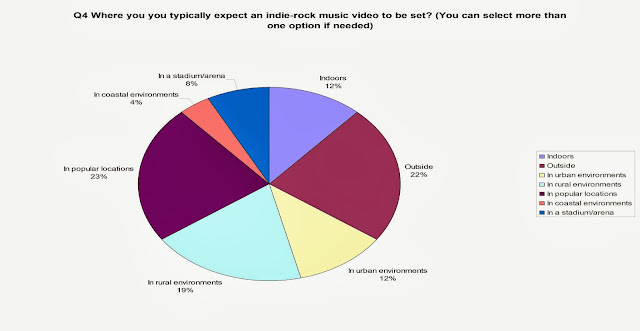
Our research shows that 22% of our audience expect an indie-rock music video to be set outside. This could perhaps be because of the 'rough-and-ready' stereotypical image, which people may associate with outside urban environments. Again, this is something that we could perhaps look to incorporate into our music video.

Our survey said that 56% of people prefer music promos with a narrative, whilst 44% of people like videos with performance elements included. Due to our relatively small sample size, these two figures are broadly similar, so we should be looking to include a mixture of both performance & narrative within our video.

Question six shows that the majority of people watch music videos on YouTube, as was initially thought. This shows that YouTube is the best place for us to upload our music video, as this is the most popular platform for people to view videos of this genre on, allowing maximum reach for our product and the band.

As a continuation from the last question, the results from question 7 show that Google tablets, along with laptops and desktops are the most popular platform for viewing music videos of this genre. With computers making up 40% of the result, smartphones making up 32% of the result and tablets the remaining 28%, this shows that the majority of people use traditional computing platforms to view music videos on. This also indicates where people choose to watch music videos of this genre - as most people watch on a computer, then they are either located at a fixed location, such as at a desk, rather than being mobile. This information helps us to decide which resolution and ratio we should use to publish our video, and also which devices we should target internet advertising.

This question shows that most people prefer videos that use illustration. This could be because people who watch these sorts of videos generally find the story and message behind the video interesting, and like this to be highlighted within the video. This is something that we should consider incorporating into our video.

Question 9 allowed us to get a feel for which other types of product people who lilke this genre choose to buy. As 40% chose to purchase clothing with their £10, this indicates that those who like this genre are conscious of fashion, and enjoy clothes shopping. 20% of people chose to purchase electronic goods, and so this indicates that these people like gadgets and technology, again suggesting that they like to keep up to date with the latest trends. This could be because most people who like this genre are under 30, as was demonstrated in question 1.
Monday, 23 September 2013
Audience Research: Methodology
CW/HWK
To undertake audience research into what our audience expected from an indie-rock music video, we created a questionnaire, and issued it to 10 people. A copy of the questionnaire can be seen below:


To undertake audience research into what our audience expected from an indie-rock music video, we created a questionnaire, and issued it to 10 people. A copy of the questionnaire can be seen below:


I designed our questionnaire so that it gave the audience the opportunity to provide quantitative answers to our questions, as these can be analysed and evaluated more easily, using graphs, charts and percentage data. This enables us to get a better feel of our audience's views on music videos for this genre, enabling us to use our audience research more effectively.
When designing question three, which asks the audience about their expectations from an indie-rock music video, I took many of the common themes, ideas and conventions that are represented in music videos from the genre that I have noticed when doing research, and added these to the list of possible options for the audience to select. I also added some conventions of music videos from other genres, as this would allow us to perhaps identify any unusual opinions or misinterpretations of the genre. In addition, I allowed people the opportunity to say whether they expect to see intertextuality in music videos, as this would enable us to see whether this is a popular feature, and whether we should look to include this in our video.
Question four was designed to assess where people usually associate indie-rock videos with being set. By producing a list of popular settings for the genre, this question will allow us to assess which location is most popular, and this may influence our decision as to where we set our video, and also what type of video we choose to produce.
Question five enables us to see whether people prefer videos with a heavy focus on performance, or whether they like videos that include more of a narrative. Again, this information will be able to influence our decision on what content to include in our music video, and the audience's opinion is something that we will look at incorporating into our video.
Question six assesses the services people use to digest music videos. This will enable us to assess modern viewing trends, as we anticipate that a large number of people will watch music videos online, using services such as YouTube. In addition, the results will give us a suggestion of where people are when they watch music videos, those who enjoy videos on the television are likely to be watching at home, whilst those who watch videos on the internet are more likely to enjoy the videos whilst sitting at a desk, or whilst away from a fixed location.
Question seven is a continuation of question six, assessing which devices people choose to watch indie-rock videos on. As well as enabling us to find out which device is most popular in each category, which could have an impact on the ratio and resolution used to produce our video, we can find out which style of device is most popular for viewing music videos. In addition, we can further judge where people are likely to be located when viewing music videos, as those who use smartphones or tablets are often likely to be on the move when viewing music videos, whereas those who use a computer, be it in desktop or laptop form, are more likely to be positioned at a fixed location, such as a home or office desk.
Question 8 asks the audience whether they prefer videos that use amplification, illustration or disjuncture. It is important to gauge public opinion of this before starting the project, as it will allow us to formulate our plans for the video, having taken on board the thoughts of our sample audience.
Finally, question 9 assists us in creating an audience profile, by finding out what other forms of goods people who watch indie-rock music videos choose to buy. This would help us to target our video and associated material more effectively, whilst also aiding us in deciding whether traditional media, such as DVD's or discs, is a better way of providing our media instead of modern media methods, which may include online services and social networks.
Thursday, 19 September 2013
Analysing Ed Sheeran's 'You Need Me, I Don't Need You'
CW


At some points, items are used to further illustrate the lyrics. For example, when the words ' Times at the Enterprise when some fella filmed me' are mentioned, an old-style camera is used on set, filming the dancer. In addition, a sofa is shown when the word 'Coutch' is sung, and this shot is repeated when the word 'Out' is sung on the next line, which reinforces the rhyming pattern.
Overall, I feel that the music video effectively compliments the lyrics of this song, helping to reinforce certain important points that perhaps the audience may not be able to understand because of the pace of which the words are sung.
Wednesday, 18 September 2013


Tuesday, 17 September 2013
Impact of Genre on the Music Promo
CW/HWK
Mumford & Sons - I Will Wait
Camera Work: The video uses lots of mid shots showing the performers on the stage. This is intersperced with close up shots, allowing us to see details of the musical instruments, along with long pan shots, which gives an indication of the size and scale of the audience. Shots from behind the stage are included, showing the audience what it must be like to perform on stage. This also gives the impression to the audience that they are privelliged people, who have been given a personal relationship with the band. In addition, soft focus shots are used, which gives the impression that the filming of the video is spontaneous, and has not been planned.
Editing: Fast-paced editing shots are used, with cuts made in time to the music. This allows the video to build up pace and gather momentum, although in the slower parts of the song, slower cuts are used. Shots that show audience reaction are also edited in at some points throughout the video, and this breaks up the action, making people want to watch the band even more. High angle pan shots are also cut into this video frequently, and this gives the audience perspective on the scale of the performance.
Mise-en-Scene: As this video is based on performance, the video is set in an arena or large outdoor music venue, which appears to be in America. Microphones, staging and instruments can all be seen, along with large TV screens that are used to show the live on screen action to the audience that are watching. The band are dressed in clothing that is synonomous with this genre.
Performance: This video focuses heavily on performance, and their relationship with the audience in the stadium. Many shots are included that show the band performing with their instruments, which show that the performers have musical talent. Many shots also show the crowd enjoying the performance and dancing
Typical Naratives: This video is based solely on the performance, and so does not include any narrative. I feel that this is an effective technique for the video, as it allows the musical talent of the band to come through. Also, this encourages the audience to focus on the lyrical content of the song, as the story is told through this medium.
Oasis - Wonderwall
Camera Work: This video uses a variety of different camera shots to present the song effectively. A mixture of mid, close up and extreme close up shots are used to show the performers and their instruments. The variety of shots makes the video more interesting, and adds to the enjoyment for the audience. Zoom shots are also used in this video, and these draw the attention of the audience onto a specific subject or item in the video. Although this video was produced in 1995, it is made to appear older, as the shots tend to be quite static, lacking any artistic flare.
Editing: In some parts of the video, the editing is quite fast paced, and shots are in time to the music. However, in other areas, cuts tend to be slower, allowing the audience to focus on the performers in the video. Cut away shots are used between the narrative and the performance, and at some points, the graphic match technique is used to link between the two scenes.
At one point, the shot has been edited so that the body of the guitar is blue, whilst the rest of the shot is in black & white, and in another scene, the same technique is applied to a hat. This technique has perhaps been used to draw attention to these objects, highlighting how these objects are more important than the other ones in the shot.
Mise-en-Scene: The performance element of the video is set in a rather neutral environment, which appears to be a factory or industrial building, whilst the narrative is set in many locations, including a cafe. Many props are used in this video, including a guitar, drum kit, staging and chairs. It appears that little artificial lighting is used in this production, which represents the band's heritage, showing that they have come from a deprived background, and where their budget for filming a music video was limited. The costumes that the performers wear in this production is fairly stereotypical with the indie-rock genre, with clothing tending to be fairly ordinary, which again represents the bands history, and makes them more popular with their target audience.
Performance: This video features a mixture of performance and narrative. The performance features the band performing in a studio, with the lead singer positioned in a chair some way in front of the rest of the band. This suggests that he is more important than the other band members. Many close up shots of the instruments being played are included, demostrating the musical talent and ability of the band.
Typical Narratives: This video uses disjuncture to tell the narrative, with seemingly random shots of clowns and darts being used to link to the narrative. This technique works effectively, as it captures the imagination of the audience, encouraging them to keep watching the video, as ultimately, all of the 'random' activities lead to the overall story, which is about the difficulty in reaching a loved one - a subject that indie-rock music commonly touches on.
Subscribe to:
Posts (Atom)


