Equilibrium
- where each story starts with something being happy and normal
Disruption
- where something happens that causes disruption and creates tension
Realisation
- the problem is realised by different characters in the narrative
Restoration
- there is then an attempt to fix the problem
Equilibrium
- once the problem is fixed, equilibrium is restored, resulting in a
happy ending
This theory has not really
been used in our music video, as it is not appropriate, as our video does
not result in a happy beginning or ending
Claude Levi-
Strauss' Narrative Theory
Focused on structure in
terms of binary oppositions
Binary oppositions are a set
of opposite values which reveal the structure of texts
Examples include Good and
Evil - many people associate evil to be the opposite of good.
In science-fiction movies,
we can see that oppositions are created by the narrative:
Earth
& Space
Good
& Bad
Humans
& Aliens
Past
& Present
Known
& Unknown
Normal
& Strange
This theory has been used in
our music video to an extent, as the narrative reflects the idea of happy
and sad times being portrayed.
Roland Barthes' Narrative Theory
Narrative/Enigma Codes
Always more than one way to read a media text
With each re-reading comes another meaning to the text
Encourages audiences to take a writer's approach to a text rather than a reader's approach
Most texts are designed for readers, taking a linear form, and takes on a pre-determined form so that audiences are simply reading information. Avoids any sort of media that may allow other connotations to be made
The Enigma theory is that any text encourages audiences to make up their own minds about something, and question what is happening
This is present in murder mysteries, where the identity of the killer is often not identified until the last moment, allowing the audience to wonder who did it
This theory is present in our music video, as the audience are left to wonder where our character is going on his journey, and why he may be going there, until the last moment
Constructed, Artificial Images - represented as being 'real people', experiencing real emotions
Images should contain a Unique Selling Point - can be copied or mocked because of it
Constructed image can be more consistent than film stars over a period of time
Not dependent on the creative input of others
TV programmes such as The X Factor represent the construction process
Groomed, styled and coached into fulfilling expectations
Record company are interested only in money
Industry and Audience
Manufactured to serve a purpose
Audiences respond to various elements of star persona
Record companies nurture and shape their stars - this is shown by the processes on TV talent shows
Tend to manufacture what they think audiences want
This leads to many stars and groups being similar
Produce stars with long-lasting appeal
'Conveyor belt'approach to new stars means talent isn't developed
Star's value may be short lived - only two years, or two albums perhaps
Increased focus on older pop stars - 'golden oldies' - means younger audiences can't identify with stars
Healthy music industry develops both younger and older generations - diverse range of stars
Ideology & Culture
Stars represent shared values and attitudes
Promote certain ideology
Audiences have interests in these values, increasing their likeability and quality
Giving opinions on issues outside of music helps to develop their likeability
Stars may start fashion trends, with fans copying their styles
Stars can ignite discussion about topics or issues via social media
Social networks give pop stars the opportunity to develop their believes and values outside of the industry
Platforms of institutional support, including radio & TV Shows, are devoted to scrutinizing stars, and the public often crave for more information about stars
Provide a focal point for cultural thinking
Character & Personality
Stars have foundation in real life - often link back to their past
Seen as a product of a particular generation
Provide audience with a stereotype to associate to
Many audience members try and conform to this stereotype
Overall image is constructed
Pop stars establish their image through their music
Artist may be unable to sustain their image over a long period of time - this is usually due to money, and being unable to create a consistent account of their character because of their extra wealth
Music magazines are often an effective way of promoting new releases and albums by bands, and we could consider placing our advert in one that is specific to our genre.
The UK-based digital magazine Electric Banana would be an ideal platform to place our advert in, as it is specifically targetted at those interested in Indie music, Alternative music and Indie-Rock music. The funky style the magazine portrays, along with the bright yellow logo, branding and large, bold font, would particularly appeal to people of the younger generation, which, as our audience research has shown, is the target audience for our video. The magazine is run predominantly by fans, for fans, and so gives people who are interested in, or who are involved in the industry the chance to contribute.
The magazine is independently owned, and the e-Magazine digital format allows them to keep publishing costs low.
The advert for the Arctic Monkeys can be seen above, which features a black background, along with the CD cover for the album in the centre. This draws attention to the product, also helping people to associate the case with the advert. The black background uses a colour that is often associated with the genre, and the use of the white writing in bold font helps to have a large impact. In addition, the use of the star ratings in the bottom left and right corners gives credibility to the brand, giving people faith and confidence in what is being sold.
The advert above is for Mumford & Sons' album 'Sign No More'. Again, a black background is used, but stills are presented in a picture frame style, which gives it an authentic, rustic feel. In a similar style to the previous advert, a white font is used, but this time, a Serif font is applied, giving a more traditional appearance. This advert features more detail than the previous one, however, giving details of the record label, and of the different tracks that are on the album.
The final advert, shown above, which is for The Master Plan by Oasis, follows many of the typical conventions that are displayed in the previous two adverts, with the black background, white font-face and photo-focus in the centre. However, this advert uses a black and white image, which draws attention to the red font that is used, and this advert also includes the price of the album, which is something that is missing from the previous two. This unusual technique perhaps highlights the different selling styles - the Arctic Monkeys and Mumford & Sons may feel that they wish to use their brand and identity to sell the album, whereas Oasis might feel that they need to use price and persuasive techniques to help boost sales figures. This advert also shows that the album is available on iTunes, but also at HMV, with the HMV logo and slogan being used to highlight this. Again, this perhaps shows that the band have worked together with HMV to create convergance between the two profiles, that benefits both parties.
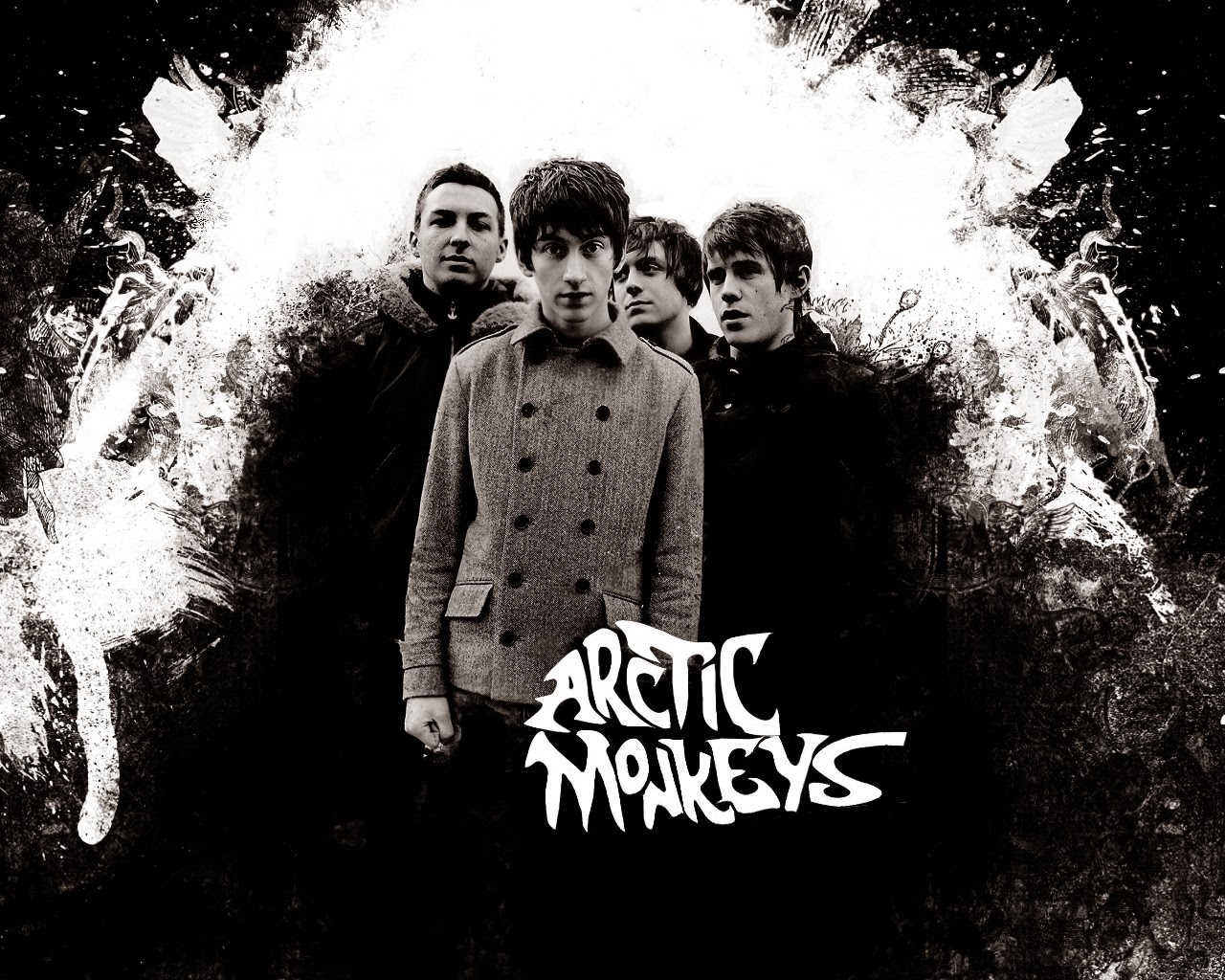
Like many CD covers from the Indie-rock genre, the Arctic Monkeys cover, which can be seen above, features members of the band. The cover has been produced to appear quite dark, which suggests negativity and depression, whilst the white effect used on the cover provides contrast. The band's name is quite small and discreet, allowing the photo to be the main focus of the artwork. In addition, this style can be used across many different types of marketing and promotional material.
The artwork for Definitely Maybe by Oasis also features a photo focus, whilst still retaining the iconic Oasis logo that has been used in much of their branding. There is still a focus on performance, as one of the members is sitting on the sofa with a guitar, although an element of disjuncture is present, with one person lying on the floor, and another sitting, facing away from everyone else. This is a theme that is potentially carried across in some of the band's music videos. In addition, the presence of wine in the shot perhaps links to the turbulent history that many of the band's audience may have.
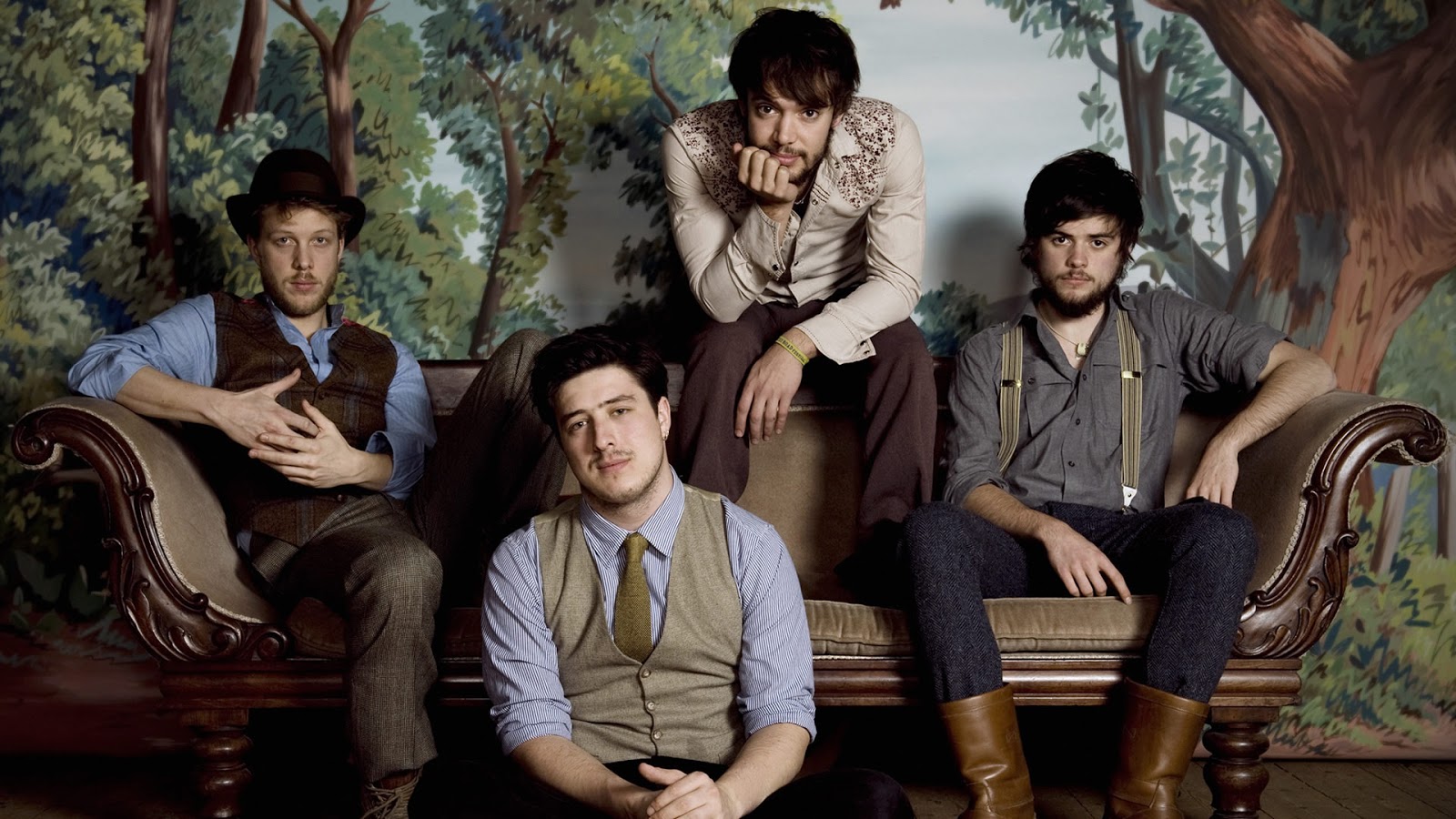
The CD cover for Babel by Mumford & Sons does, like the other covers, retain the use of a photo focus, featuring members of the band. Here, the band appear separated from the rest of the scene, with the use of vintage props and items giving the cover and old feel. This perhaps indicates towards the band's background, and as the band are positioned in the centre of the shot, this draws attention to them. In addition, the shot appears quite informal, showing the relationship the band member's have between each other.
The music video for 'Do you Wanna Know?' by the Arctic Monkeys breaks many of the typical conventions for an indie-rock promo, as is shown below.
The music video begins for the first 1 1/2 minutes in a similar style to that shown above. This helps to focus on the sound & the performance, helping the audience to focus on the music. This breaks typical conventions for an Indie-Rock promo, as it does not begin with actual footage, which usually shows the band.
The lines then develop to show feet & legs of a person. This continues the theme and style that was developed in the last shot, and the low angle of the shot may perhaps make the audience feel quite intimidated, as they may feel that the person is walking towards them. Furthermore, the upward angle makes the character feel quite imposing. The shot develops to show female characters dancing, which again breaks the typical conventions of an indie-rock promo, as they are usually based heavily on performance, focusing on the instruments and technique possessed by the band members, instead of focusing on narrative and dancing.
The next shot develops in a similar way, but at this point, the artwork becomes more complex and developed. The shot focuses on cars racing, producing connotations of speed and adrenaline, but this is represented in an exaggerated and comical way. The angle used makes the ramps appear larger, and allows us to see three cars in the distance, representing chaos and disorder - themes that are often portrayed in promotional videos for this genre.
The next shot retains the same style as the previous ones, but introduces colour. This could in many ways be considered an intertextual reference to the Children's TV series 'The Flinstones', with the colouring and exaggerated style being considered similar in many ways. This reference perhaps can be associated with the band's ethos and viewpoint, with the American 'happy-go-lucky' style coming across in this frame.
The final shot goes back to the previous style of white lines on a black background, and appears to show a male and female kissing. The use of this style suggests simplicity and purity, whilst the composition of the shot suggests that the couple are in a very clean, plain environment. Relationships are often at the core of any indie-rock promo, and this shot exemplifies this idea in the video.
We have chosen to use Idols & Upsets by Chasing Tigers as our song for our music video. Chasing Tigers are an unsigned band from Norwich, and are made up of four members - Laurence Brooks, Dylan McCarthy, Jay Wiltshire & James Maas.
They are known for their Indie Pop/Rock music, seeing them sell out all of their gigs last year.
The 'Indie-Rock' genre was created in the United Kingdom & United States of America in the 1980's, as genre of alternative rock. The term was used to describe bands who retained an 'outsider' perspective as bands became more mainstream in the 1990's. This is also related to the Indie-Pop genre that developed in 1986.
Many famous indie-rock bands have developed over the years, including Oasis, The Arctic Monkeys and Mumford & Sons. These bands have been highly successful, using their brand and identity to help them sell records. These bands use their alternative, laid-back style to give the genre an identity.
Mumford & Sons used unconventional instruments and performance style in their music video of 'I will Wait', which defines the Indie-Rock genre. In the video, Banjos and Acoustic Guitars are used, which are perhaps not instruments that people would associate with a popular modern song. Also, the performers are presented in a somewhat 'rough and ready' style - unshaven and wearing open-neck shirts and jeans, which is perhaps not style that people would associate with successful bands. In many ways, this adds to the appeal of the genre for many, as people feel that it allows their core values and beliefs to come through.
Many messages are conveyed in the lyrics of songs in the Indie-Rock genre, and that is highlighted below in the lyrical analysis of Roll with It by Oasis.
Indie-rock bands typically comprise of males, who are often based in either the United States or the United Kingdom.
They represent people who come from 'ordinary' backgrounds, and often choose not to live the lifestyle of artists who have been incredibly successful, in the way that bands such as Take That or One Direction may choose to do.
Indie-rock bands often dress in a casual way, which is how many people in their target audience may also choose to dress. This helps them to fit in with their target audience, and also represents their background and history.
Members of Indie-Rock bands are often middle aged - usually in their 30's or 40's - meaning they have enough real life experience so that their audience believe in their message. This perhaps means that fans have more respect for the members of indie-rock bands than they would for a younger 'boy band', and this adds to the appeal of the genre.
Indie rock bands tend to be fairly 'in' with the current fashions. They always dress in fairly conventional and normal clothing, usually casual, therefore not being completely unique like punk bands or creating their own new fashions like emo and heavy metal bands tend to do. Pop is usually fairly similar to indie rock costume but pop sometimes tends to use extravagant costumes and unique ideas to convey the morale of the song or just generally the artist of the music. For example, Lady Gaga is one pop artist who dresses in a very strange way regardless of her audience or what the lyrics of the song she is singing are. This leads to her having a fairly true identity and being unique within the pop industry.
Indie-rock lyrics always seem to be about life in general, they sometimes talk about things to do with relationships but they can also talk about other more random things like Foster the People do with their song 'Pumped Up Kicks' which basically relates to the life of a young person within society who obviouysly isn't as fortunate as other children that surround him.There are lots of indie-rock bands who sing about more random yet still common ideas like Foals, Empire of the Sun and Passion Pit. Although most indie-rock bands do wear traditionally fairly normal casual clothing, Empire of the Sun are one particular group that do not follow these conventions and in some of their muysic videos, they dress very strangely, especially in their video for 'We are the People'.
The conventions of an indie-rock promo:
- Location - tends to be fairly perfromance-based and if it isn't, it usually relates to the moral of the lyrics or the title of the song, indie-rock bands never really use disjuncture as it just isn't conventional for the genre.
- Costume - is usually quite casual and normal in relation to society's norms.
- Props - band perfomance-related props are used quite often in this genre as it portrays to the audience the atmosphere of a live-perfomance as well as shows off the talents of the band members.
- Camerawork - Lots of movement shots as well as mid-shots that are used effectively to show the band members faces as well as them playing their instruments, again promoting the talents of the band to the audience.
- Editing - Fast-paced editing adds to the atmosphere of the music and maintains the audience interest by using a good variety of shots and effects to 'spice up' the overall promo.
There are 2 different types of CD covers for indie-rock bands and performers.
The first of these is band covers; These generally show the members of the band in a fairly normal environment but in a humorous or traditional manner. For example, the Mumford and Sons 'Sigh No More' album cover shows the 4 members of the band standing in a shop window highlighting that they are a casual band. The album covers also sometimes show the band members in fairly unique or unconventional surroundings. Foals are a good example of this with their album cover for 'Total Life Forever' which portrays the band members in a surreal environment (underwater) and shows their carefree style of music by the fact that they are deep underwater without any equipment or breathing apparatus. The other types of album cover and magazine advert for indie-rock bands is an abstract view of the band or artist. Yet again, Foals are another good example of this with their album cover for 'Antidotes' which shows a drawing of a man with his mouth agape and a type of stained glass window image held within his mouth.
Also, they tend to be quite colourful so that they stand-out to the audience as well as being quite complex or random which shows a good understanding of the genre as I would describe indie-rock music as being catchy and definitely highlighting a carefree and fast-paced way of life. For example, Empire of the Sun and Foster the People highlight this randomness as well as the colourful abstract type of CD cover.